
A great design can still disappoint if it is printed on the wrong product. For apparel creators, Etsy sellers, and small businesses, DTF decals vs vinyl stickers is really a surface, finish, and workflow decision, not a question of which option is universally better.
We see this mix-up often. A seller orders a hard-surface decal for a shirt, or uses a vinyl sticker where they wanted the raised, printed-on look of a UV DTF transfer. Choosing the correct option upfront protects margins, avoids replacement orders, and gives customers a product that feels intentional.
The Practical Difference Between DTF Decals and Vinyl Stickers
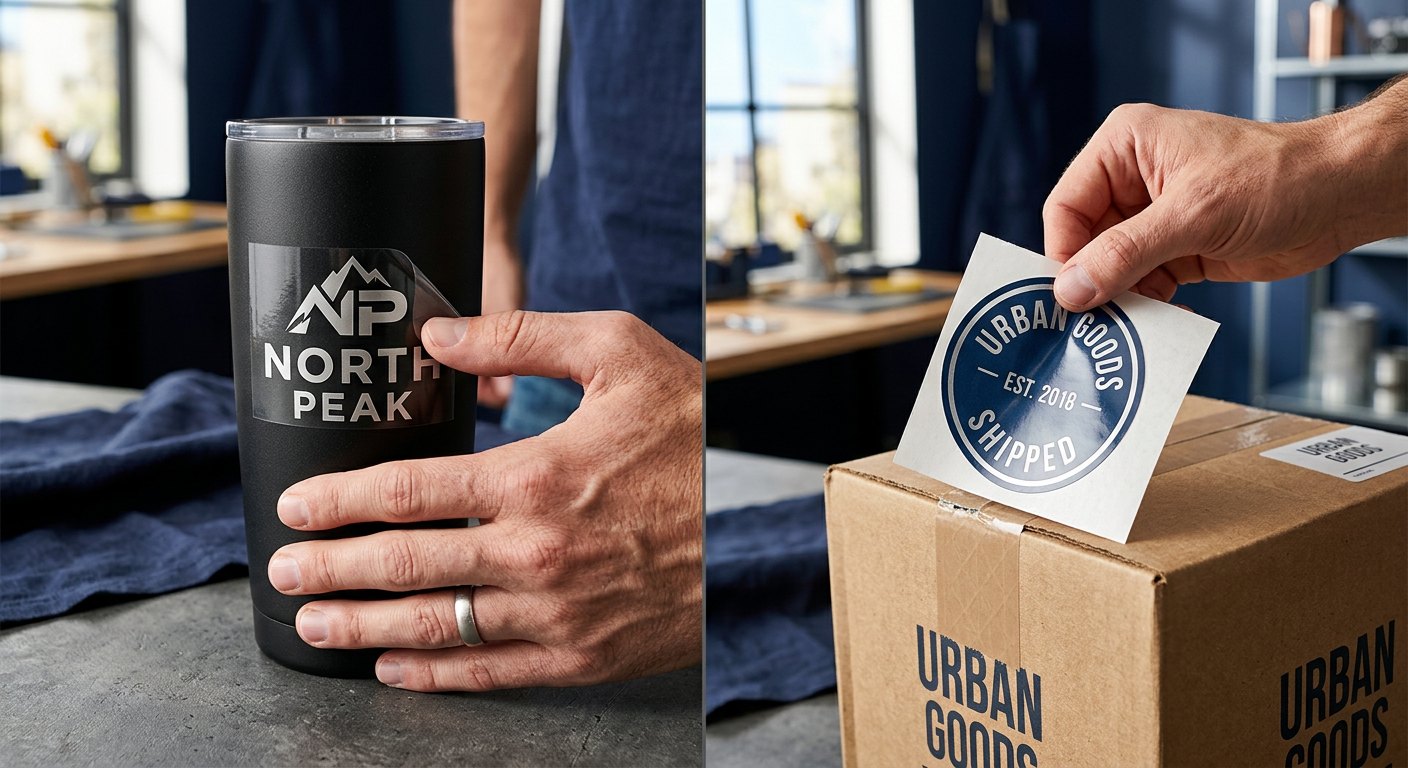
UV DTF decals are pressure-applied transfers for smooth, hard surfaces. Vinyl stickers are adhesive-backed printed or cut pieces that stay on their own backing and are peeled directly onto the item.
For clarity, this article uses “DTF decals” to mean UV DTF stickers, not standard heat-press DTF transfers for shirts. Standard DTF transfers belong on fabric. UV DTF decals belong on clean, hard, nonporous surfaces such as tumblers, glass, acrylic, coated metal, and many plastics.
| Feature | UV DTF Decals | Vinyl Stickers |
|---|---|---|
| Best surfaces | Tumblers, glass, hard goods | Packaging, laptops, flat products |
| Application | Peel, place, rub, remove carrier | Peel and stick |
| Look | Glossy, raised, transfer-style | Flat printed or cut sticker |
| Best artwork | Full color, fine detail | Simple to detailed designs |
| Repositioning | Limited once applied | Depends on adhesive type |
A vinyl sticker is often the simpler choice for flat packaging, promotional handouts, mailers, notebooks, and giveaway bundles. It is familiar, fast to apply, and available in materials ranging from removable paper to waterproof vinyl.
A UV DTF decal makes more sense when you want branding to look integrated with the product itself. The transfer leaves the artwork on the surface without a traditional sticker border, which is especially effective for custom drinkware, candle jars, product containers, acrylic signage, and branded gift sets.
Choose by Surface First, Not by Artwork
The item you are decorating should make the decision easier. UV DTF and vinyl are both useful, but they behave differently because their materials and application methods are different.
When UV DTF Decals Are the Better Fit
Choose UV DTF decals when the item is smooth, rigid, and meant to look premium. They are especially strong for full-color logos with tiny details, gradients, small lettering, or layered art that would take too long to cut and weed from vinyl.
Good examples include:
- Stainless tumblers and water bottles
- Glass cups, jars, and bottles
- Acrylic signs and display pieces
- Plastic containers and packaging
- Coated metal accessories
- Hard-shell cases and promotional products
The surface must be clean, dry, and free of texture. We recommend testing one sample whenever you are working with powder-coated drinkware, soft-touch coatings, heavily curved products, or unknown plastics. Application is a one-shot process, so align carefully before rubbing down the transfer.
For hard-goods branding, our custom UV DTF stickers are printed for fast peel-and-apply production. They are waterproof, scratch-resistant, and available with no unit minimums, which helps small shops test a product line before committing to a larger run.
When Vinyl Stickers Are the Better Fit
Choose vinyl stickers when you need flexible distribution, a removable option, or a conventional sticker feel. They are practical for shipping-box seals, laptop decals, marketing inserts, short-term promotions, and products where buyers expect a peel-and-stick label.
Vinyl also gives you more control over sticker formats. You can use die-cut shapes, kiss-cut sheets, clear stock, removable adhesive, permanent adhesive, matte finishes, glossy finishes, or specialty looks such as holographic film. That variety makes vinyl useful when the sticker itself is part of the experience.
Durability depends heavily on the specific film, ink, laminate, adhesive, surface, and exposure. For perspective, a 2025 3M technical data sheet lists up to five years of outdoor durability for one extended-life vinyl label material under its stated test conditions. That is a material-specific result, not a blanket promise for every vinyl sticker.
The Look and Feel Your Customers Notice
UV DTF decals create a dimensional, glossy result that can make a logo appear printed directly onto a product. The design has a tactile feel and usually no visible outer border when the art is prepared correctly.
Vinyl stickers look like stickers, and that is often a benefit. A crisp die-cut edge, a branded border, or a holographic finish can make the sticker collectible. Think of a coffee shop handing out logo decals, a maker including freebies in every order, or a band selling sticker packs at an event.
The customer experience should guide the choice:
- Use UV DTF for a polished, permanent-looking branded object.
- Use vinyl for a shareable, removable, or collectible sticker.
- Use standard DTF for a T-shirt, hoodie, tote, or other fabric item.
- Use glitter DTF when apparel needs sparkle without cutting and weeding glitter vinyl.
This distinction matters for multi-product launches. A boutique might use standard DTF for a shirt graphic, glitter DTF for a limited spirit-wear edition, UV DTF for matching tumblers, and vinyl stickers for order inserts. The art can match across every item, but the decoration method should match the substrate.
Production Time, Labor, and Order Flexibility
UV DTF reduces hands-on production steps for detailed hard-surface art. There is no heat press, no cutting, and no weeding after the decal arrives. The tradeoff is that placement needs to be accurate because lifting and repositioning can damage the transfer or reduce adhesion.
Vinyl stickers are also fast at the point of use, especially when they arrive pre-cut. However, producing vinyl in-house can add print, laminate, cut, weeding, and quality-control steps depending on the design and equipment. Simple shapes move quickly. Tiny lettering, intricate outlines, and multi-layer cut vinyl can slow a shop down.
For apparel, standard DTF stays in a separate lane. A press-ready transfer helps us move full-color garment art without making you cut or weed a complicated design. Review our DTF heat press instructions and troubleshooting steps before production, especially when you are using a new blank garment or press.
The Day-12 Reorder Test for Product Sellers
By day 12 of a launch, the best decoration method is usually the one that makes reorders simple. If customers are buying tumblers one at a time, a ready-to-apply UV DTF decal keeps fulfillment lean. If they are adding your logo stickers to laptops, water bottles, and journals, vinyl sticker packs are easier to bundle and ship.
We recommend tracking three details during the first dozen days of sales:
- Where customers use the product. A tumbler used daily needs a different finish than a thank-you sticker placed on tissue paper.
- How long application takes. Time spent lining up, weeding, or correcting placement directly affects profit on low-quantity orders.
- Which designs repeat. Your best-selling logo may deserve a larger stock order, while seasonal art is better suited to short runs and flexible quantities.
This approach gives small businesses practical data without overbuying inventory. It also helps you avoid treating every product like it needs the same print method.
A Straightforward Buying Decision
Choose UV DTF decals if you are decorating clean, hard surfaces and want a glossy, high-end transferred look. Choose vinyl stickers if you want flat, peel-and-stick branding that works well for packaging, promotional use, and flexible distribution.
If you are still deciding, order samples of your strongest design in both formats and apply them to the actual product you sell. A real tumbler, jar, shipping box, or laptop tells you far more than a screen mockup.
Order Press-Ready Prints From Tempe
Need full-color apparel transfers or hard-surface branding without a large production commitment? Five Star DTF is Arizona’s go-to print partner for small businesses, Etsy sellers, apparel creators, and print shops that need premium prints quickly. We offer same-day printing for qualifying orders, no minimum quantities, free shipping on orders over $100, and local pickup in Tempe.
Order online: https://fivestardtf.com/product/dtf-transfers/
📍 Local pickup: 305 S Rockford Dr Ste B, Tempe, AZ 85281
Frequently Asked Questions
Can I put a UV DTF decal on a shirt?
No. UV DTF decals are made for smooth, hard surfaces, not fabric. For T-shirts, hoodies, tote bags, and other textiles, use a heat-applied DTF transfer designed for garments.
Are DTF decals the same as standard DTF transfers?
No. Standard DTF transfers use heat and pressure to apply artwork to fabric. UV DTF decals are pressure-applied transfers for hard goods, so the materials and application methods are different.
Do vinyl stickers work on curved tumblers?
Some vinyl materials can work on gentle curves, but the result depends on the sticker size, film flexibility, adhesive, and tumbler coating. For detailed logo art on smooth drinkware, UV DTF is often easier to apply cleanly.
Can I remove a UV DTF decal later?
Removal can be difficult and may require careful lifting, heat, or adhesive-removal methods. If removability is a priority, choose a vinyl sticker material specifically designed with removable adhesive.
Which option is better for small orders?
Both can work well for small orders. UV DTF is efficient for short-run drinkware and hard-goods customization, while vinyl stickers are ideal for inexpensive branded inserts, product labels, and promotional bundles.
Do I need a heat press for vinyl stickers or UV DTF decals?
No. Both vinyl stickers and UV DTF decals are applied without a heat press. A heat press is needed for standard DTF transfers and other apparel-decoration methods.
Summary
UV DTF decals and vinyl stickers solve different branding problems. UV DTF is the polished hard-surface option for tumblers, glass, acrylic, and similar products, while vinyl stickers are the versatile choice for packaging, promotions, and traditional sticker use.
The smart move is to match the product to the surface, expected lifespan, finish, and fulfillment workflow. That gives customers a better result and keeps your production process profitable as orders grow.
The Bottom Line
The best choice is the one that fits the item in your customer’s hands. Use UV DTF when the design needs to look built into a hard product, use vinyl when the sticker itself is part of the product experience, and keep fabric decoration in the heat-press DTF category.
A clear product decision at the beginning saves labor, protects your brand, and makes the next reorder easier to fulfill.
About Five Star DTF
Five Star DTF is Arizona’s leading provider of
DTF transfers, Glitter DTF prints, UV DTF stickers,
and Sublimation transfers — offering same-day printing, fast nationwide shipping,
and convenient local pickup in Tempe, Arizona.
We proudly serve Tempe, Scottsdale, Phoenix, Mesa, Gilbert, Chandler, and all of Arizona,
helping creators, apparel brands, small businesses, and print shops produce premium, press-ready transfers with
vivid color, soft stretch, and long-lasting durability.
There are no setup fees, no minimum orders, and turnarounds are always fast.
Our Top Products
- DTF Transfers
- Glitter DTF Transfers
- UV DTF Stickers
- Sublimation Transfers
- Press Instructions & Tips
- Contact & Local Pickup
Artwork Help
Need your artwork cleaned, fixed, resized, or made print-ready? We offer background removal, vectorizing, color correction, and gang sheet layout.
Ready to Print?
Order DTF Transfers or
Upload Your Artwork to get started today.
All orders over $100 ship free — printed in Tempe, AZ and shipped statewide and nationwide.