

A great DTF print starts before the heat press closes. The film you choose affects release, detail, production speed, surface feel, and how consistently your jobs move from one shirt to the next.
For most small apparel shops, Etsy sellers, and creators, the best DTF film for printing is not simply the highest-priced roll or the fastest-peel option. It is the film that matches your printer, powder, curing method, garment mix, and production pace. A dependable standard film is often the smartest choice for repeatable T-shirts, hoodies, team apparel, and short-run custom orders.
Choose Film by Workflow, Not Hype
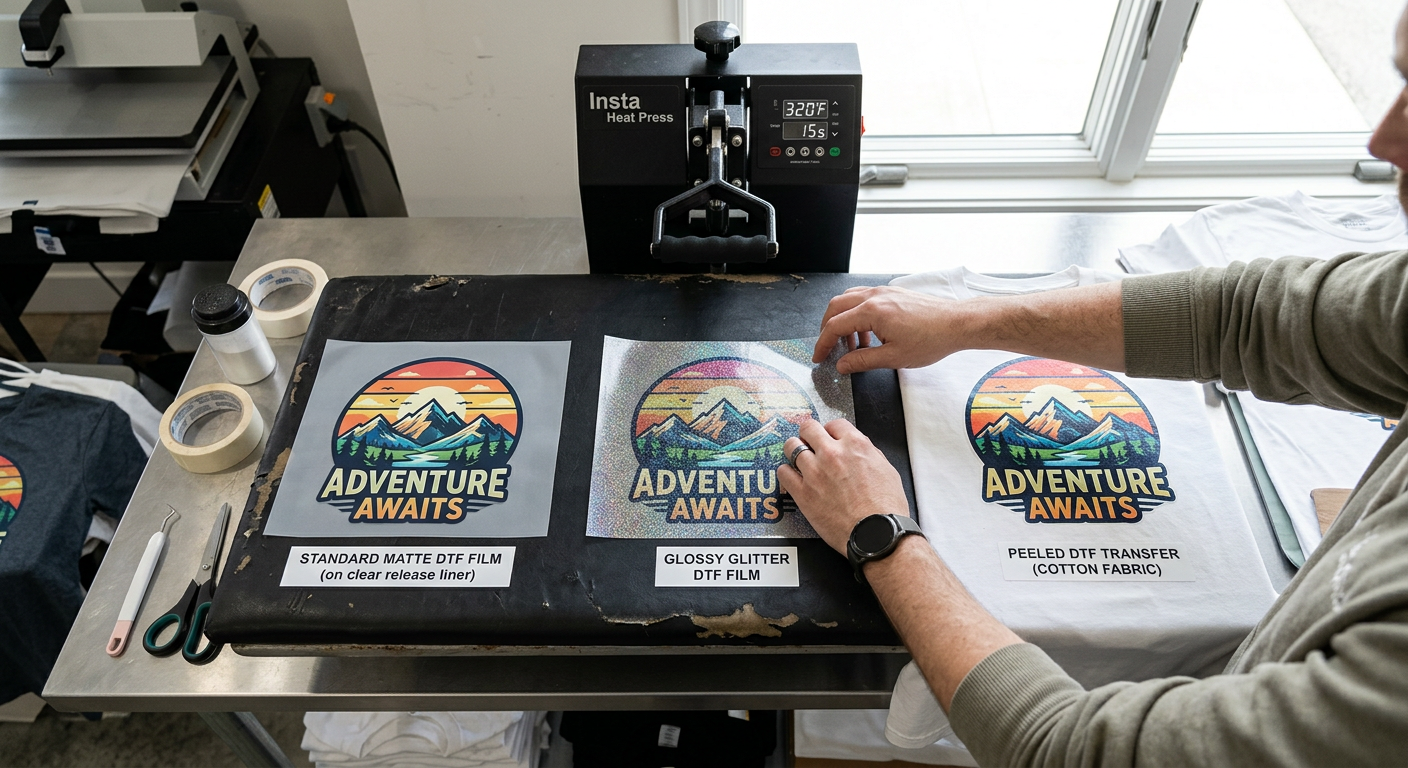
The right film is the one that supports your actual production routine. Hot peel can keep an active press moving, while cold peel gives a more deliberate workflow that many decorators prefer for careful inspection and consistent release.
| Film Type | Best Fit | Main Advantage | Watch For |
|---|---|---|---|
| Hot peel | Fast production runs | Quick carrier removal | Requires consistent pressing |
| Cold peel | Detailed, controlled jobs | Time to cool and inspect | Slower press workflow |
| Glitter film | Fashion, spirit wear, boutiques | Sparkle built into printed areas | Slightly more texture |
| Specialty film | Specific printer or finish needs | Purpose-built results | Test before large runs |
We recommend choosing a peel style only after testing it with your own heat press and garment blanks. Epson notes in its DTF Film Printing Guide that conditions vary by film, powder, curing equipment, and ink coverage. That is why a small test press is not optional when you change a film, powder, or blank garment. (files.support.epson.com)
What Makes a DTF Film Worth Using
A dependable DTF film should print cleanly, hold wet ink without unwanted movement, accept powder evenly, release at the expected peel stage, and leave sharp edges after pressing. If one of those stages becomes unpredictable, the film is costing you time even if the roll price looks attractive.
Start With a Clean, Consistent Coating
The coating is where the job is won or lost. A quality film should support fine type, small gaps, halftones, and smooth color transitions without forcing you to overcompensate in your RIP settings.
Watch for warning signs during production:
- Ink beads up, spreads, or looks uneven on the printed sheet.
- Powder sticks outside the printed image and creates a dirty edge.
- Tiny details release inconsistently after pressing.
- The carrier becomes difficult to remove even when temperature, time, and pressure are correct.
- Results shift from one sheet to the next without any workflow change.
These symptoms can come from more than film. Humidity, powder condition, curing, printhead performance, and heat-press accuracy all matter. The practical move is to change one variable at a time and record the result.
Match the Peel to Your Production Speed
Hot peel film is built for efficiency. It can make sense for busy shops pressing repeated designs, event apparel, or larger batches where every extra cooling cycle slows fulfillment. STAHLS describes hot peel DTF as a quick application option because the carrier can be removed without waiting for the transfer to cool. (assets.stahls.com)
Cold peel film is a solid fit when you want a controlled rhythm, especially for detailed artwork, new blanks, or jobs where your team benefits from inspecting each print before the carrier comes off. At Five Star DTF, our published starting point is 315°F, firm-to-high pressure, a 15-second press, cold peel, and an optional five-second finishing press. Always begin with the instructions supplied for the transfer in hand, then test on the actual garment. (fivestardtf.com)
Do Not Treat Glitter Film Like Standard Film
Glitter DTF is a specialty finish, not a substitute for everyday matte film. It is the stronger choice for boutique drops, cheer gear, dance shirts, school spirit wear, festive merch, and bold logo treatments where the shimmer is part of the design.
The glitter effect is embedded in the film layer, so every printed color takes on sparkle. Light colors reflect it more intensely, while darker colors create a subtler shimmer. For a close look at this finish and its garment uses, see our custom glitter transfer options. (fivestardtf.com)
A Shop-Test Method That Prevents Expensive Mistakes
The best way to identify the best DTF film for printing in your shop is a structured mini test, not a one-shirt guess. Run the same artwork through every candidate film using the same printer profile, powder, cure, press, and garment blank.
Use One Design That Reveals Weaknesses
Build a test file with small lettering, a thin line, a soft gradient, solid white, a dense color block, and a few transparent gaps. That combination exposes weak ink holdout, rough powder behavior, poor release, and edge failure faster than a simple bold logo.
Press at least three samples per film. One sample can look perfect by chance. Three samples give you a better read on repeatability, which matters far more when you are fulfilling customer orders.
Track the Results That Affect Profit
Use a simple production sheet and score each film on:
- Print surface behavior
- Powder coverage and cleanup
- Curing consistency
- Peel effort
- Fine-detail retention
- Stretch and edge adhesion
- Finish after the final press
- Time required per finished garment
A film that costs a little more but prevents reprints can be the better value. The same logic applies to hot peel versus cold peel. The faster choice is only faster if it releases cleanly and does not create avoidable quality checks.
Keep Film, Powder, and Press Settings Connected
Film is not a standalone purchase. It is part of a system that includes ink, adhesive powder, curing, garment material, and press calibration. Epson specifically advises that temperature and time can vary by film and powder, so copying settings from an unrelated transfer is a fast way to create adhesion problems. (files.support.epson.com)
For everyday press-ready transfers, follow our DTF application instructions before changing settings. Pre-pressing the garment, removing lint, keeping seams off the platen, and using even pressure can solve many issues that appear to be film problems.
The Best Film Choice for Common Apparel Jobs
There is no universal winner across every garment and order type. Use the job itself to guide the decision.
Standard Tees, Hoodies, and Everyday Brand Merch
Choose a reliable standard matte DTF film. It is the practical option for broad product catalogs, full-color logos, short runs, cotton, polyester blends, and recurring client orders. Consistency should be the priority.
Fast Event Shirts and Busy Press Days
Choose a tested hot peel film when your setup supports it. Fast carrier removal can improve output, but only if your press delivers stable heat and even pressure across the platen.
Premium Boutique, Cheer, and Spirit Apparel
Choose glitter film when sparkle supports the artwork. It adds a visible specialty finish without the weeding and layering workflow of glitter vinyl. For a normal logo that needs a softer, more understated finish, standard film is usually the better fit.
Tumblers, Packaging, Glass, and Hard Goods
Do not use apparel DTF film for hard-surface products. Use UV DTF stickers for smooth hard goods instead. They are designed for peel-and-stick decoration rather than heat-press application on fabric.
Why Fast Transfer Fulfillment Still Needs Quality Control
Speed matters when you are running a shirt business, but repeatability protects your reputation. A transfer that looks strong in a single test but fails under a busy production schedule can create reprints, delayed shipping, and unhappy buyers.
Five Star DTF is Arizona’s go-to print partner for creators who need press-ready results without owning or maintaining a DTF printer. We print in Tempe, offer no-minimum orders, provide same-day printing and shipping on qualifying orders, local pickup for Phoenix-area creators, and free shipping on orders over $100. Our standard DTF transfers are tested for 100-plus washes when pressed correctly. (fivestardtf.com)
Frequently Asked Questions
Is hot peel or cold peel film better for DTF printing?
Neither is automatically better. Hot peel is often the better fit for fast, repeatable production, while cold peel is often preferred when you want a slower workflow with more time to inspect release and adhesion.
Can I use the same DTF film on cotton and polyester?
In many cases, yes, but the garment and transfer settings still need testing. Polyester can introduce dye-migration concerns, especially on dark or highly dyed garments, so use suitable blanks and test before producing an order.
Does thicker DTF film always mean better quality?
No. Thickness alone does not determine coating performance, print detail, peel behavior, or finished feel. Judge film by consistent results through your entire process, not by one specification on a product listing.
Why is powder sticking outside my printed design?
Excess powder can result from heavy ink, uneven shaking, static, moisture, or film and powder compatibility issues. Remove excess powder carefully before curing, then inspect your ink limits and environment if the problem continues.
How should I store unused DTF film?
Keep it flat, clean, dry, and away from extreme heat or humidity. Protect opened film from dust and moisture, and avoid bending corners or placing heavy items on top of sheets.
Can I reuse a DTF carrier film after pressing?
No. DTF carrier film is single-use. Reusing it can lead to poor transfer quality and unreliable adhesion. (fivestardtf.com)
Build a Better Transfer Workflow With Five Star DTF
Need premium transfers without spending your day tuning film, powder, and printer settings? Order press-ready DTF transfers online from Five Star DTF for fast production, no minimums, and free shipping over $100.
We are printed in Tempe and shipped nationwide. For local pickup, visit us at 305 S Rockford Dr Ste B, Tempe, AZ 85281.
Summary
The best DTF film for printing is the film that performs consistently in your full workflow. Match hot peel to speed-focused production, cold peel to controlled application, and glitter film to designs that genuinely benefit from a specialty finish.
Test with real artwork, real garments, and repeatable settings. That small discipline saves material, protects turnaround time, and gives every customer a cleaner final garment.
Final Takeaway
Film choice should make production easier, not add another variable to fight. Start with a dependable standard film, validate peel behavior on your own press, and reserve specialty finishes for jobs where they add clear value.
When your process is stable, you can quote faster, press with confidence, and spend more time building your apparel business instead of troubleshooting avoidable reprints.
About Five Star DTF
Five Star DTF is Arizona’s leading provider of
DTF transfers, Glitter DTF prints, UV DTF stickers,
and Sublimation transfers — offering same-day printing, fast nationwide shipping,
and convenient local pickup in Tempe, Arizona.
We proudly serve Tempe, Scottsdale, Phoenix, Mesa, Gilbert, Chandler, and all of Arizona,
helping creators, apparel brands, small businesses, and print shops produce premium, press-ready transfers with
vivid color, soft stretch, and long-lasting durability.
There are no setup fees, no minimum orders, and turnarounds are always fast.
Our Top Products
- DTF Transfers
- Glitter DTF Transfers
- UV DTF Stickers
- Sublimation Transfers
- Press Instructions & Tips
- Contact & Local Pickup
Artwork Help
Need your artwork cleaned, fixed, resized, or made print-ready? We offer background removal, vectorizing, color correction, and gang sheet layout.
Ready to Print?
Order DTF Transfers or
Upload Your Artwork to get started today.
All orders over $100 ship free — printed in Tempe, AZ and shipped statewide and nationwide.