

Introduction
Pressing transfers should feel simple, but cotton and polyester behave very differently under heat. If you want sharp color, a soft hand feel, and long-lasting results, you need the right press settings and a few smart habits.
That is where how to press dtf on cotton and polyester matters most. The good news is that once you understand fabric type, pressure, and peel timing, you can get consistent results on T-shirts, hoodies, uniforms, and team gear without guesswork.
What Makes Cotton and Polyester Different
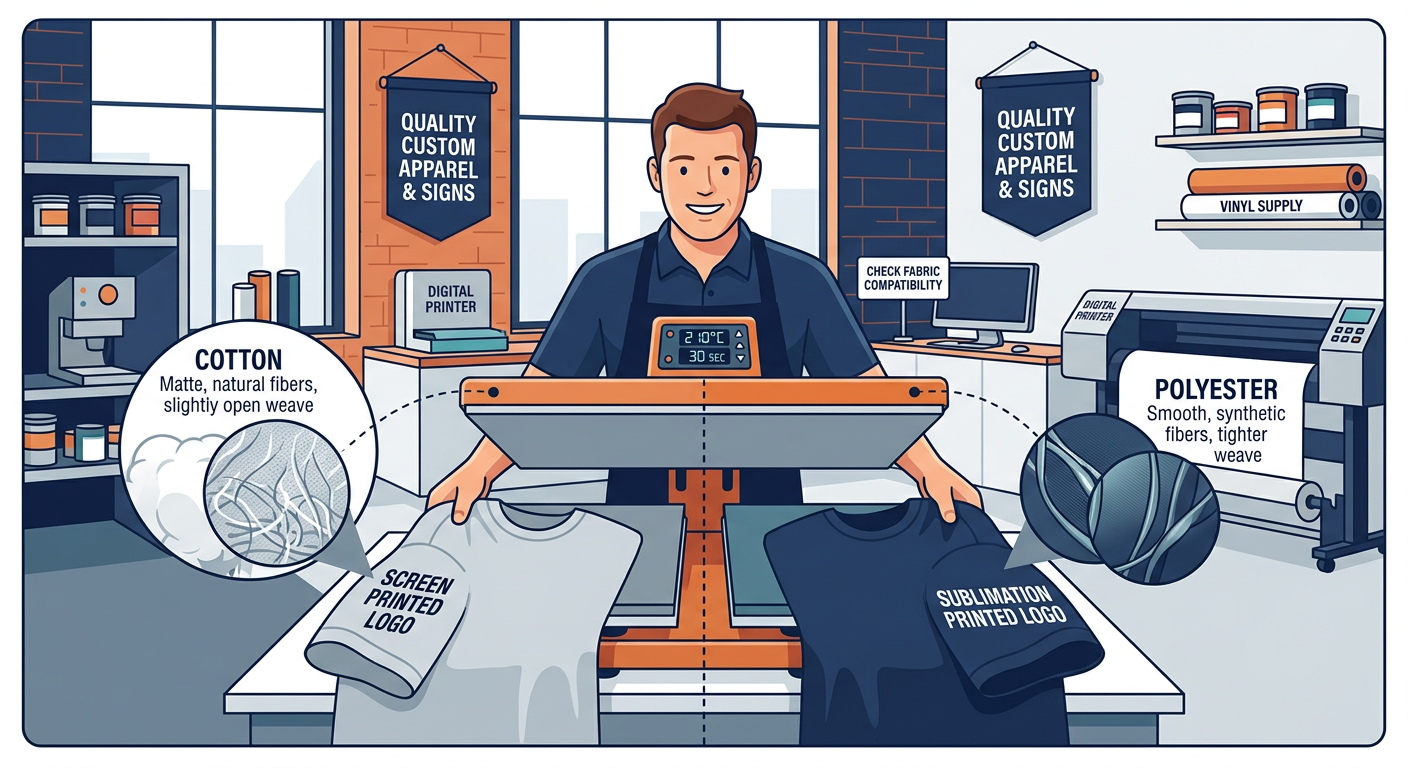
Cotton handles heat well, which makes it forgiving for most transfer work. Polyester is more sensitive, so too much heat can cause shine, dye migration, or distortion, especially on darker garments.
That means your press approach should change based on the shirt. A great result on cotton can become a problem on polyester if you use the same temperature and dwell time without adjustment.
Recommended DTF Press Settings
For most jobs, start with the transfer maker’s instructions, then test on scrap garments when possible. If you need a reliable baseline, a medium to firm press with steady pressure is usually the best place to begin.
Cotton Settings
- Temperature: around 300°F to 320°F
- Press time: about 10 to 15 seconds
- Peel: follow the transfer type, either hot peel or warm peel
- Finish press: 5 to 10 seconds with parchment or a finishing sheet
Polyester Settings
- Temperature: around 275°F to 300°F
- Press time: about 8 to 12 seconds
- Use lower heat to protect the fabric
- Consider a quick finish press with a protective sheet
Step-by-Step Pressing Process
Start by pre-pressing the garment for a few seconds to remove moisture and wrinkles. This helps the transfer bond evenly and reduces the chance of steam marks or uneven adhesion.
Next, place the transfer in the correct position and press with firm, even pressure. After pressing, peel based on the transfer instructions, then do a short post-press to lock in the finish and improve wash durability.
How to Handle Common Problems
If the design lifts at the edges, your pressure may be too light or your press time may be too short. If the print looks glossy or warped, your heat may be too high, especially on polyester.
For cotton, under-pressing often shows up as weak adhesion or a rough feel. For polyester, overheating can create dye migration or a pressed-in shine that ruins the final look.
Best Practices for Cotton Shirts
Cotton is usually the easiest fabric for direct-to-film transfers. You can work with brighter colors, heavier graphics, and larger designs while still getting a clean, durable finish.
Tips for better cotton results
- Pre-press every shirt
- Keep your platen clean
- Use consistent pressure
- Do a final press for a smoother hand feel
Best Practices for Polyester Shirts
Polyester needs a lighter touch. This is especially important for performance shirts, jerseys, and moisture-wicking apparel, where heat sensitivity is higher.
Tips for better polyester results
- Lower the temperature
- Shorten press time if needed
- Test for dye migration on dark garments
- Use a protective sheet during the finish press
Where Five Star DTF Helps
If you want press-ready transfers that are made for real production, Five Star DTF is built for speed and consistency. Their DTF Transfers are a strong choice for shops, Etsy sellers, and apparel creators who need reliable output fast.
If you also sell accessories or want a retail-ready finish, their UV DTF Stickers and Glitter DTF Transfers can help expand your product line. For application help, the Instructions page is a useful reference.
FAQ
Can I press DTF on both cotton and polyester?
Yes. DTF works on both fabrics, but polyester usually needs lower heat and closer attention to prevent damage or shine.
Do I need different settings for cotton and polyester?
Yes. Cotton can handle more heat, while polyester usually performs better with reduced temperature and shorter press times.
Should I pre-press the shirt first?
Absolutely. Pre-pressing removes moisture and helps the transfer bond more evenly.
What happens if I press polyester too hot?
You may see shine, dye migration, or fabric distortion. Always test before full production runs.
Is a final press important?
Yes. A quick finish press helps improve durability, smooth the design, and give the print a more professional look.
Ready to Print Faster
If you need dependable transfers, same-day pickup, or fast nationwide shipping, Five Star DTF keeps your production moving. Order online at https://fivestardtf.com/product/dtf-transfers/ or visit local pickup at 305 S Rockford Dr Ste B, Tempe, AZ 85281.
Printed in Tempe, shipped nationwide, and ready for your next run.
About Five Star DTF
Five Star DTF is Arizona’s leading provider of
DTF transfers, Glitter DTF prints, UV DTF stickers,
and Sublimation transfers — offering same-day printing, fast nationwide shipping,
and convenient local pickup in Tempe, Arizona.
We proudly serve Tempe, Scottsdale, Phoenix, Mesa, Gilbert, Chandler, and all of Arizona,
helping creators, apparel brands, small businesses, and print shops produce premium, press-ready transfers with
vivid color, soft stretch, and long-lasting durability.
There are no setup fees, no minimum orders, and turnarounds are always fast.
Our Top Products
- DTF Transfers
- Glitter DTF Transfers
- UV DTF Stickers
- Sublimation Transfers
- Press Instructions & Tips
- Contact & Local Pickup
Artwork Help
Need your artwork cleaned, fixed, resized, or made print-ready? We offer background removal, vectorizing, color correction, and gang sheet layout.
Ready to Print?
Order DTF Transfers or
Upload Your Artwork to get started today.
All orders over $100 ship free — printed in Tempe, AZ and shipped statewide and nationwide.